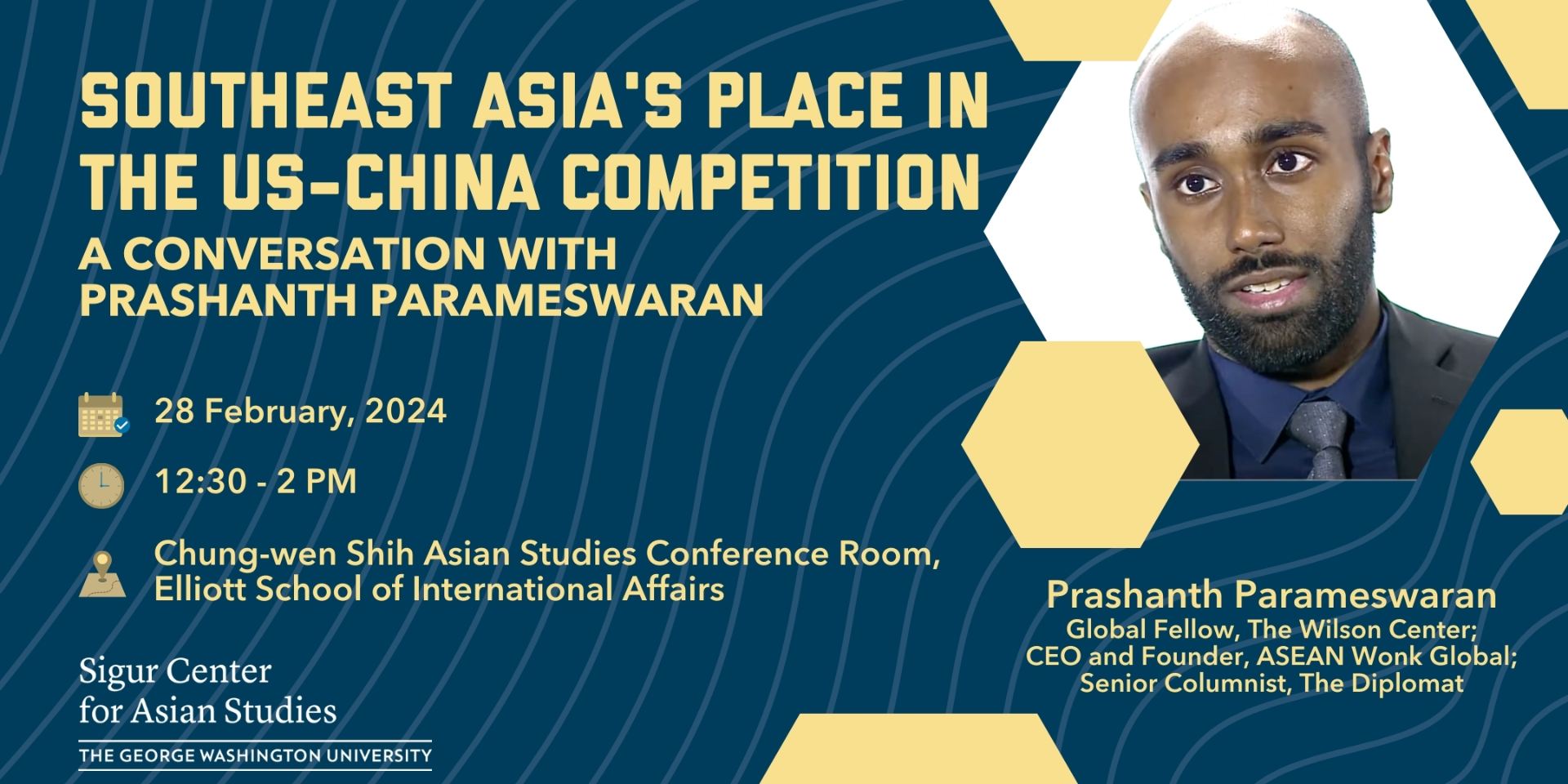
[2/28/24] Southeast Asia’s Place in the US-China Competition

Wednesday, February 28, 2024

12:30 pm – 2:00 pm

Chung-Wen Shih Asian Studies Conference Room Suite 503

Elliott School of International Affairs

1957 E Street NW Washington, D.C. 20052

Many Southeast Asian nations have found themselves caught between the United States and China as tensions continue to increase between the two states. The region’s key military and economic positions have only served to intensify that pressure. The decisions that these countries will make will undoubtedly have global impacts felt around the world. Prof. William M. Wise, the Chair of the Southeast Asia Forum, and Dr. Prashanth Parameswaran from the Woodrow Wilson Center will discuss the complicated position that these countries face as well as the interests the United States and China have within the region.

Join the Sigur Center and the Southeast Asia Forum as we discuss the role that Southeast Asia will play and its impacts on US-China relations. RSVP today! Free lunch will be provided.

Speaker
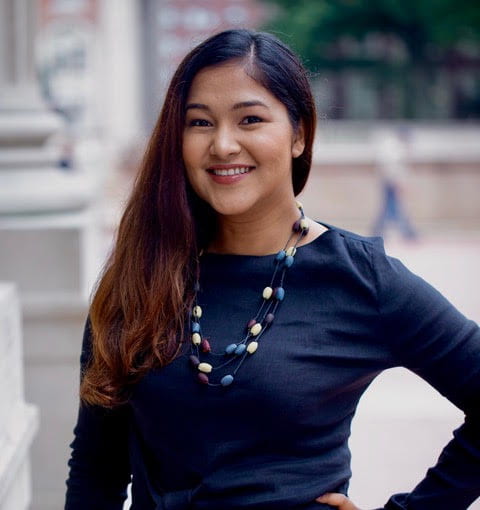
Headshot of Wai Wai Nu smiling at the camera

Dr. Prashanth Parameswaran is a fellow with the Wilson Center’s Asia Program, where he produces analysis on Southeast Asian political and security issues, Asian defense affairs, and U.S. foreign policy in the Asia-Pacific. He is also the CEO and Founder of ASEAN Wonk Global, a research hub that produces the weekly ASEAN Wonk BulletBrief newsletter; Senior Columnist at The Diplomat, one of Asia’s leading current affairs publications; and an Advisor at BowerGroupAsia, a strategic advisory firm focused on the Indo-Pacific region.

A political scientist by training, Dr. Parameswaran is a recognized expert on Asian affairs and U.S. foreign policy in the region, with a focus on Southeast Asia and politics and security issues. He has conducted grant-based field research across the region, consulted for companies and governments, and taught courses affiliated with the U.S. Department of Defense and the U.S. Department of State. His policy insights, research and commentary have been published widely in the United States and across the region in leading publications and journals including CNN, The Washington Post, The South China Morning Post, The Straits Times, Asia Policy and Contemporary Southeast Asia.

Moderator
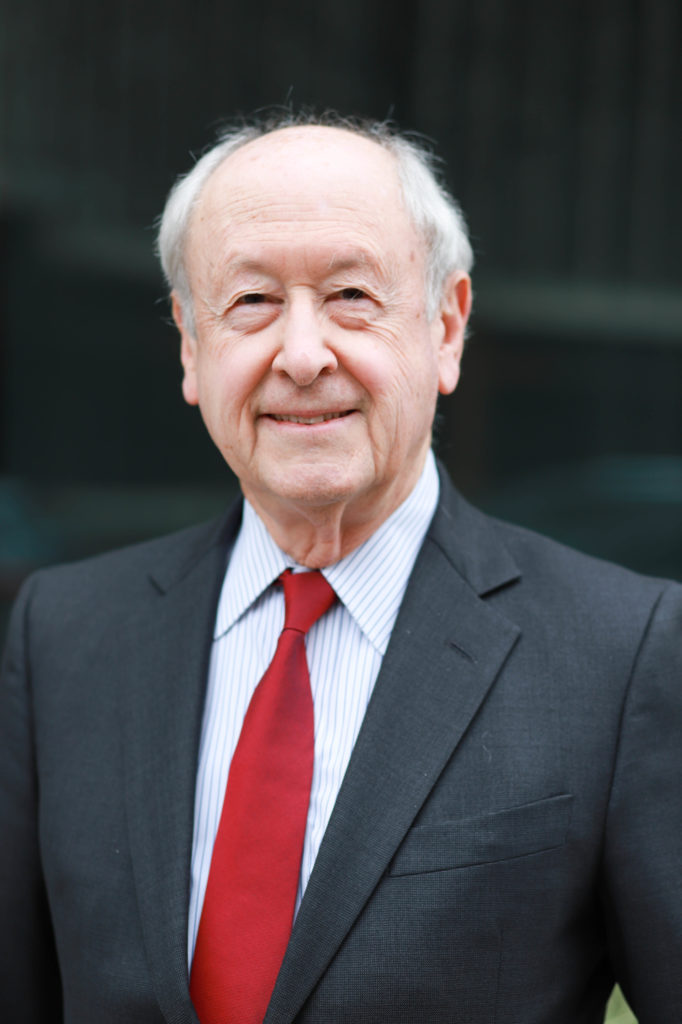
A picture of William Wise

William M. Wise chairs the Southeast Asia Forum, a project to promote the study of Southeast Asia at colleges, universities and research centers in the Mid-Atlantic region. He is a former Non-Resident Fellow at the Stimson Center, affiliated with the Southeast Asia Program.

Professor Wise’s government and teaching career focused on defense, security and intelligence issues in Asia. From 2005 to 2019 he managed the Southeast Asia Studies program at the School of Advanced International Studies (SAIS), Johns Hopkins University, and taught courses on Southeast Asia and intelligence problems in Asia. Prior to teaching at SAIS, he was Adjunct Professor of the Practice of International Affairs at the Elliott School of International Affairs (ESIA), George Washington University. He was a Public Policy Scholar at the Woodrow Wilson Center in Washington in 1999.

Professor Wise’s government experience spanned more than three decades. He was Deputy National Security Advisor to the Vice-President; Chief of Policy at the U.S. Pacific Command (now U.S. Indo-Pacific Command); and Deputy Director, for Policy Planning, East Asia & Pacific Region, Office of the Secretary of Defense. Earlier, he served in various positions in the U.S. Intelligence Community in Washington and overseas. He retired from the U.S. Air Force as a Colonel in 1997.

Professor Wise received his undergraduate degree from Amherst College and master’s degree from the University of Hawaii.
Sigur Center logo with line art of Asian landmarks

[3/1/2024] New Books in Asian Studies: The Collapse of Nationalist China

Friday, March 1, 2024

2:00 PM – 3:30 PM ET

Lindner Family Commons Room 602

Elliott School of International Affairs

1957 E Street NW Washington, D.C. 20052

When World War II ended Chiang Kai-shek seemed at the height of his power-the leader of Nationalist China, one of the victorious Allied Powers in 1945 and with the financial backing of the US. Yet less than four years later, he lost the China’s civil war against the communists. Offering an insightful chronological treatment of the years 1944–1949, Parks Coble addresses why Chiang was unable to win the war and control hyperinflation. Using newly available archival sources, he reveals the critical weakness of Chiang’s style of governing, the fundamental structural flaws in the Nationalist government, bitter personal rivalries and Chiang’s personal lack of interest in finance. This major work of revisionist scholarship will engage all those interested in the shaping of twentieth-century history.

Join the Sigur Center as we discuss this monumental work of scholarship with history Parks M. Coble. RSVP today!

Speaker

A picture of Larry Repeta smiling and looking at the camera

Parks M. Coble is the James S. Sellers Professor of History, having joined the department in August 1976. He teaches surveys of general East Asian history, covering China, Japan, Korea, and Vietnam, and specialized courses on modern China and Japan.

Parks Coble’s research field is 20th century China with special emphasis on the political history of Republican China (1911-1949), the history of Chinese business in the 20th century, and Sino-Japanese interactions. Recent publications have included a study of Chinese businessmen living in occupied China during World War II, and of the anti-Japanese movement in China in the 1930s. His current project examines the collapse of the Chiang Kai-shek government in China in 1949 by analyzing the tragic consequences of hyperinflation in China during the period from 1944 until 1949. The Japanese conquest of East China had isolated the Chiang stronghold in the interior and left the Chinese government with few financial resources. Chiang chose to simply print money which lead to disastrous consequences. After Japanese surrender there was no “peace dividend” so the erosion of the currency simply accelerated. New archival sources permit an in depth analysis of the decision making process within Chiang’s government.

Moderator

portrait of Celeste Arrington posing with arms crossed in black outfit

Edward A. McCord is Professor of History and International Affairs at The George Washington University, specializing in Chinese history. He is the author of The Power of the Gun: The Emergence of Modern Chinese Warlordism (University of California Press) and Military Force and Elite Power in the Making of Modern China (Routhledge). He has published numerous articles, focusing mainly on the role and impact of the military in modern Chinese society, in journals such as Modern China, Twentieth-Century China, and Modern Asian Studies. Besides teaching graduate and undergraduate students in modern and pre-modern Chinese history at The George Washington University, Professor McCord lectures frequently on Chinese history at the Foreign Service Institute and the Smithsonian Institution’s Campus on the Mall program. He is also a member of the editorial board of Modern China.

Professor McCord received his Ph.D. in Chinese history from the University of Michigan in 1985. Following a post-doctoral fellowship at the University of California-Berkeley, he was an assistant professor of history at the University of Florida in Gainesville Florida, where he received several awards for undergraduate teaching. In 1994 he moved to The George Washington University in Washington, D.C., as an associate professor, also serving as Director of the University’s East Asian Studies Program. In the period from January 1998 to June 2006 he served successively as the Associate Dean for Students and Curriculum, Faculty and Research, Faculty and Student Affairs, and Senior Associate Dean for Management and Planning for GW’s Elliott School of International Affairs. He is also the founder and Director of the Elliott School’s Taiwan Education and Research Program. From September 2011 to June 2014, he served as the Director of the Sigur Center for Asian Studies.

 
Sigur Center logo with line art of Asian landmarks